
AMD has announced its Q3 2025 financial results and officially confirmed that its next-generation 2nm EPYC Venice processors will launch in 2026. CEO Dr. Lisa Su also revealed that the company’s upcoming Instinct MI400 AI accelerator lineup will debut during the same period, marking a new phase in AMD’s data center and AI strategy.
Zen 6 and MI400 to launch together in 2026
AMD reported $9.2 billion in revenue for the third quarter of 2025 — a 36% year-over-year and 20% quarter-over-quarter increase. The data center segment generated $4.3 billion, the client and gaming division brought in $4 billion, while embedded systems accounted for $857 million in revenue.
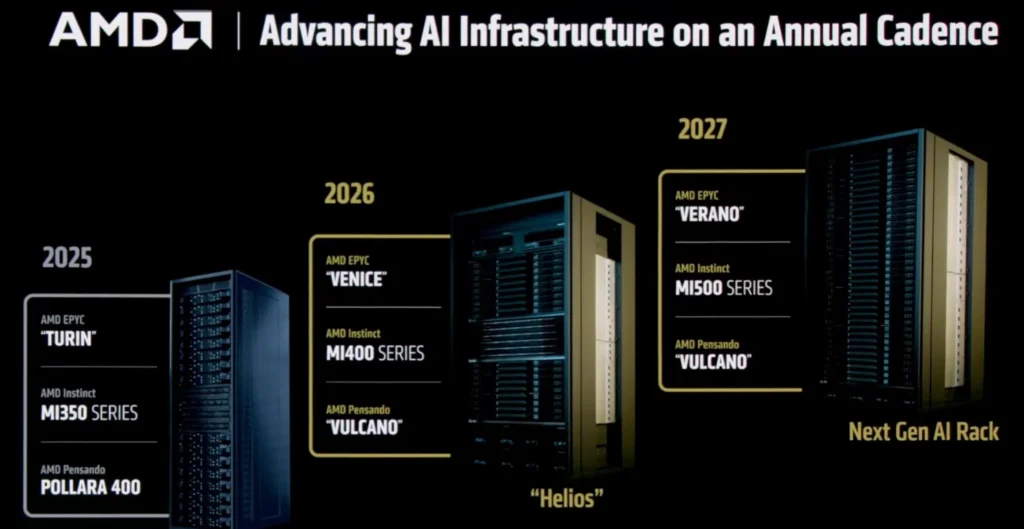
Dr. Lisa Su confirmed that the next-generation EPYC Venice CPUs are built on TSMC’s advanced 2nm process and based on the Zen 6 architecture. The Venice silicon, currently being tested in AMD’s labs, is said to deliver significant performance, efficiency, and compute density gains compared to the Zen 5-based Turin chips. Multiple cloud providers have already brought their first Venice-based systems online ahead of launch.
AMD will also introduce its Instinct MI400 AI accelerator family in 2026. The MI400 series delivers up to 40 PFLOPs of compute power, paired with 432 GB of HBM4 memory and 19.6 TB/s bandwidth. The lineup will compete directly with NVIDIA’s Rubin platform and form the backbone of AMD’s new Helios rack-scale data center solution, designed for large-scale AI training and inference workloads.
Major partners such as Oracle and the U.S. Department of Energy are already on board. Oracle plans to integrate tens of thousands of MI450 GPUs into Oracle Cloud Infrastructure starting in 2026. Meanwhile, the U.S. Department of Energy’s upcoming Discovery supercomputer — located at Oak Ridge National Laboratory — will use a combination of EPYC Venice CPUs and MI430X GPUs to drive AI-powered scientific computing at scale.
AMD’s desktop business also continues to perform strongly. Ryzen 9000 processors have achieved record sales thanks to their gaming and productivity performance, while Radeon RX 9000 GPUs based on the RDNA 4 architecture are seeing steady pricing and increasing demand.
Dr. Lisa Su confirmed that AMD will share more details about Zen 6, the MI400 series, and the Helios platform at the company’s Financial Analyst Day on November 11, 2025. With these developments, AMD is preparing to enter 2026 with a major architectural leap across both data center and AI markets.

